

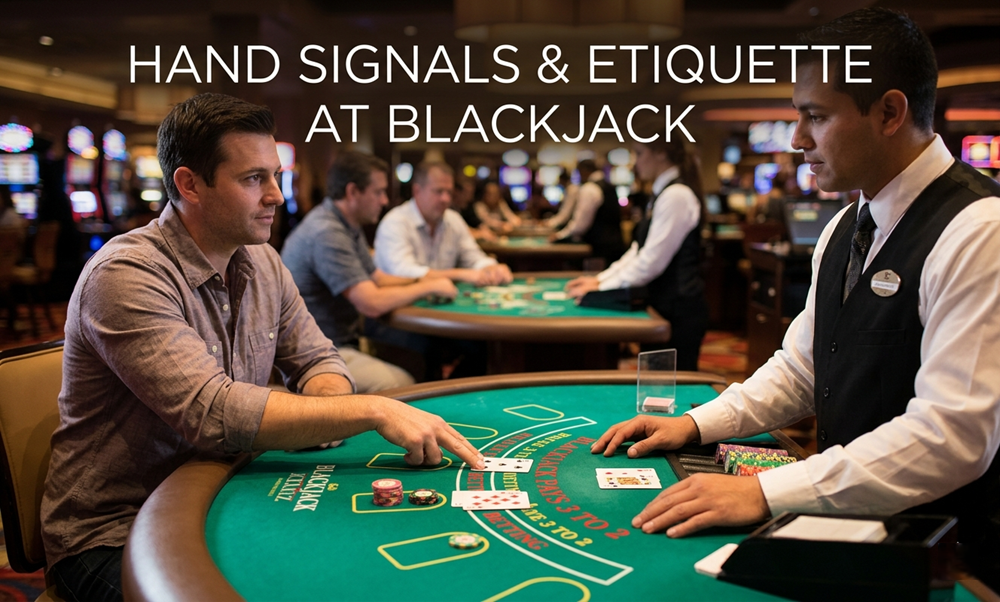
First-timers at a blackjack table often make the same mistake: they say what they want out loud and expect the dealer to act on it. Sometimes it works. More often, the dealer gestures toward the table or says “signal, please.” The moment of confusion that follows is something every regular player has seen dozens of times.
The truth is, blackjack hand signals aren’t just etiquette — they’re a casino security requirement. Understanding why they exist and how to use them correctly makes you a more confident and efficient player from your very first hand.
Why Hand Signals Are Required at Blackjack Tables
Casinos use overhead cameras to record every moment of play on the floor. If a verbal dispute arises — “I said stand, not hit” — the camera footage must clearly show what the player intended. Verbal instructions alone aren’t captured reliably on video.
Hand signals create an unambiguous, camera-visible record of every decision. This protects the player as much as the casino. It’s also why dealers will occasionally remind you to signal even after you’ve spoken your decision aloud.
The Core Blackjack Hand Signals
Facedown Games (Handheld Shoe Games)
If your cards are dealt face down, you’re allowed to hold them. The signals are slightly different:
- Hit: Scratch the edge of your cards lightly on the felt toward yourself
- Stand: Slide your cards under your bet (tucking them partway beneath your chips)
- Double Down: Turn your cards face up, then place your additional bet beside the original
- Split: Turn your cards face up, then place the second bet next to the original
Faceup Games (Standard Shoe Games)
More common in today’s casinos — cards are dealt face up and you don’t touch them:
- Hit: Tap the felt with one finger, or scratch the table surface toward yourself
- Stand: Wave your hand horizontally over your cards, palm down
- Double Down: Place an additional bet beside your original bet (same amount), hold up one finger
- Split: Place a second matching bet next to the first; hold up two fingers to distinguish from a double
Signal Summary Table
| Decision | Faceup Game Signal | Facedown Game Signal |
|---|---|---|
| Hit | Tap or scratch felt | Scratch cards toward you |
| Stand | Wave hand over cards | Slide cards under chips |
| Double Down | Bet beside + one finger | Flip cards, bet beside |
| Split | Equal bet beside + two fingers | Flip cards, bet beside |
| Surrender | Draw finger across felt | Say “surrender” (most casinos) |
Surrender — The Signal Nobody Teaches You
Late surrender (if offered) is signaled by drawing your index finger across the felt in a horizontal line behind your bet, as if you’re cutting across the table. Many players don’t know this signal exists, which is part of why surrender gets underused. Verbally saying “surrender” usually works too — but always confirm with a physical gesture.
Pro Tips for Clean, Clear Signaling
- Don’t hover your hands over the table. Keep signals brief and decisive. A quick, clear tap is better than a lingering gesture the camera might misread.
- When splitting, spread the second bet wide enough that it’s clearly separate from the original. A cluster of chips can look like a messy original bet to a camera.
- Watch one hand before you play. Standing at a table for a few minutes before sitting lets you observe the signal rhythm naturally.
Common Mistakes to Avoid
- Placing split or double chips on top of the original bet. Always bet beside, never on top — on-top placement signals a parlay on some other games and confuses dealers.
- Verbal-only decisions without signaling. Always pair verbal intentions with a physical signal. This protects you if a dispute arises.
- Touching cards in a faceup game. In shoe games, you’re not supposed to handle the cards at all. The dealer may remind you, but it can create an awkward moment.
- Waving too ambiguously for a stand. A half-hearted wave can be misread. Make the horizontal palm-down gesture clear and deliberate.
FAQs
Q: What if I signal incorrectly by accident? A: Let the dealer know immediately before any card is dealt. In most cases, a clear, immediate clarification will be honored. Once the card is dealt, the action stands.
Q: Do online blackjack games require hand signals? A: No — online games use buttons for all decisions. Hand signals are specific to live table play.
Q: Can I ask the dealer what the correct signal is? A: Absolutely. Dealers are trained to guide new players. Asking before the hand starts is perfectly appropriate.
Q: What does it mean when a player knocks the table? A: A single knock on the felt is the standard signal for “hit” in faceup games. It’s a widely recognized and accepted gesture.
Conclusion
Blackjack hand signals take about five minutes to learn and a session or two to internalize completely. Once they’re second nature, the game moves faster, disputes disappear, and you’ll look like a confident regular rather than a first-timer. Learn the four core signals before you sit down, and always pair verbal intentions with a physical gesture. The cameras are watching — and now they’re on your side.